Quick answer
Herringbone uses rectangular blocks laid at right angles, giving a broken zigzag. Chevron uses blocks with angled ends that meet in a point, giving a continuous V. Both take more material, more cutting and more time than straight planks, so both cost more to lay.
The difference at a glance
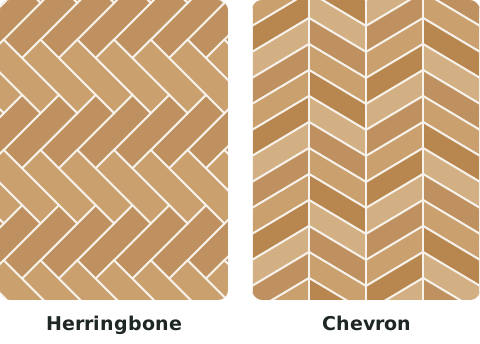
| Herringbone | Chevron | |
|---|---|---|
| Block shape | Rectangular | Ends cut at an angle |
| How blocks meet | The end of one block meets the side of the next | Angled ends meet in a straight line |
| The look | A staggered zigzag with a woven feel | Clean, continuous V shapes |
| Feels | Classic and relaxed | Sharper and more formal |
Where each one works
- Herringbone is the more forgiving of the two. It suits living rooms, bedrooms and entrance halls.
- Chevron draws a strong line down the room. It suits longer spaces and rooms where you want the floor to lead the eye in one direction.
- In a small room, smaller blocks keep either pattern in proportion. Large blocks need space to read as a pattern.
Which floors come in these patterns
The patterns are most often laid in engineered wood, where the grain of real timber changes direction with every block. Some laminate and SPC ranges are also made in herringbone formats. A pattern needs planks made for it, usually in left and right versions, so it cannot be improvised from ordinary straight planks.
Why a patterned floor costs more
- More cutting. Every block at the edge of the room is cut to fit.
- More wastage. Offcuts from a pattern are harder to reuse than offcuts from straight planks.
- More time. The first rows set the whole pattern, so they are laid slowly and checked often.
- A flatter base. Many short joints show up unevenness more than long planks do, so the subfloor needs to be right.
A patterned floor costs more than the same wood laid straight, and your quotation states the difference. For the base figures, see wooden flooring cost in Hyderabad.
Planning the layout
- Decide which way the points run. Towards the main window or along the length of the room are the usual choices.
- Centre the pattern on the room or on a feature such as a doorway, so the cuts at each side match.
- Consider a plain border of straight planks where the pattern meets the walls.
- Keep the pattern to one or two rooms. It has more effect as a feature than as the floor of the whole home.
Common questions
Which costs more, herringbone or chevron?
Often chevron, because every block has its ends cut at an angle and the points must line up exactly. Your quotation gives the figure for each.
Does a pattern make a room look smaller?
Not if the block size suits the room. Small blocks in a small room keep the pattern in proportion.
Can a herringbone floor go over tiles?
Sometimes. It depends on the product, and the base has to be flat, because short blocks show up unevenness.
Is it a passing trend?
Both patterns have been laid in wood for centuries, so they are unlikely to date a room. What changes is the tone and the block size in fashion. See what else is current in flooring and wall trends for 2026.
Tell us the rooms, the rough area and the look you want, and request a free quote. Our own team assesses the space and installs the floor.